- English
- Español
- Português
- русский
- Français
- 日本語
- Deutsch
- tiếng Việt
- Italiano
- Nederlands
- ภาษาไทย
- Polski
- 한국어
- Svenska
- magyar
- Malay
- বাংলা ভাষার
- Dansk
- Suomi
- हिन्दी
- Pilipino
- Türkçe
- Gaeilge
- العربية
- Indonesia
- Norsk
- تمل
- český
- ελληνικά
- український
- Javanese
- فارسی
- தமிழ்
- తెలుగు
- नेपाली
- Burmese
- български
- ລາວ
- Latine
- Қазақша
- Euskal
- Azərbaycan
- Slovenský jazyk
- Македонски
- Lietuvos
- Eesti Keel
- Română
- Slovenski
- मराठी
- Srpski језик

From “Don’t Forget to Lock the Door” to Seamless Access: How Smart Locks Became Your Home’s Invisible Guardian
After being locked out for two hours, Mr. Lin and his newlywed wife finally decided to replace their old door lock with a smart lock. Little did they know, this forced upgrade would open the door to a smarter lifestyle.
That evening, both Mr. Lin and his wife realized they had left their keys inside after work. The two-hour wait outside their own door led them to reconsider: what role should a lock—this most common yet easily overlooked everyday item—actually play?
They were unaware that the global smart lock market is undergoing unprecedented transformation. According to market analysis, global smart lock sales reached $5.847 billion in 2025, and this figure is expected to continue growing in the coming years.
01 Unlocking a New Life: Real User Stories of Smart Locks
Our high-paced lives often make us neglect basic security needs until an unexpected situation forces us to rethink. The experience of Mr. Lin and his wife is not an isolated case.
In Kaohsiung, Taiwan, the life of a single mother, Ms. Chang, was completely transformed by a smart lock. Juggling dropping her child at school, rushing to work, and returning home to help with homework, her greatest fear was forgetting her keys.
She shared, “I used to dread going out with my child and forgetting the keys. Once, my child waited outside for me after school, my phone died, and it was a real scare.” After installing a smart lock with biometric capabilities, the lock now automatically recognizes her approach, eliminating the need to fumble through her bag for keys.
The convenience of smart locks isn’t limited to the younger generation. An elderly couple in their seventies in Taichung ended their daily key-related squabbles after installing an electronic lock supporting palm vein recognition and EasyCard access.
“My wife would often go for a morning walk and forget her keys. Sometimes, I’d take out the trash and accidentally lock her out,” the husband explained. Now, each uses their preferred method to enter, without needing to remember passwords or carry physical keys.
02 Market Trends: From Mechanical Replacement to Smart Home Hub
The smart lock industry has evolved from being a simple mechanical replacement to the core of home security. In the first half of 2025, full-channel sales of smart door locks in China reached 8.97 million units, a year-on-year increase of 6.8%.
Rapid market growth is closely tied to technological advances. Smart lock technology has developed a pattern of “dual-track parallel development in biometrics”: facial recognition, with its seamless experience, holds over half the market share, while palm vein recognition is rapidly rising in the premium market due to its anti-forgery and high-precision features.
As the penetration rate of smart locks supporting voice assistants and AI large language models increases, competition in this sector has shifted from hardware specs to ecosystem synergy. In terms of product form, the triple-combo design of “peephole + large screen + facial recognition” has become standard.
According to Research Nester’s predictions, the smart lock market size had already exceeded $3.19 billion by 2025 and is projected to reach $15.73 billion by 2035, with a compound annual growth rate (CAGR) of approximately 17.3% during the forecast period.
The North American market is particularly prominent, expected to hold about 37% of the global smart lock market share by 2035, driven mainly by widespread smart home adoption and advanced technology integration.
03 Industry Challenges: The Hidden Worries Behind Growth
Amidst rapid market growth, the smart lock industry also faces numerous challenges. The specter of price wars lingers, with some manufacturers pushing facial recognition lock prices below a thousand yuan, leading to material compromises and frequent after-sales disputes.
Notably, the strange phenomenon of “volume increase but value decrease” has begun to appear. In 2024, full-channel retail volume for smart locks grew by 8.6%, while retail value actually decreased by 0.9%, reflecting how price competition erodes industry value.
Security challenges are equally concerning. A spot check by the State Administration for Market Regulation showed a 12% failure rate for smart locks in Q1 2025, with biometric modules being a high-risk point. As IoT devices, smart locks are vulnerable to cyber attacks, potentially endangering home security.
Everyday consumer issues also warrant attention. Incidents like smart locks jamming suddenly, batteries dying, or systems freezing are not uncommon. If these technical problems aren’t properly resolved, they directly impact user experience and industry reputation.
04 Design Innovation: The America Smart Lock Tailored for the North American Market
Among numerous smart lock designs, the America Smart Lock represents an innovative approach, specifically focused on meeting the unique needs of the North American residential market. Unlike traditional single-lock designs, it employs a split lock design, completely separating the everyday latch lock from the more secure deadbolt lock.
The advantage of this design is that it meets the need for daily convenience while providing an additional layer of protection when home security requires an upgrade. The compact shape of the America Smart Lock allows it to blend harmoniously with various door designs, reducing visual intrusion.
Market analysis indicates that the deadbolt lock segment within the smart lock market is projected to hold a 46% share by 2035, thanks to its robust security features. The two-bolt design of the America Smart Lock aligns perfectly with this trend, combining convenience and safety.
Considering the specific characteristics of the North American market, including climate conditions and building standards, the America Smart Lock has been specially optimized to ensure stable operation under various environmental conditions, providing reliable smart security solutions for North American households.
05 Product in Practice: Smart Deadbolt Door Lock — FM 31
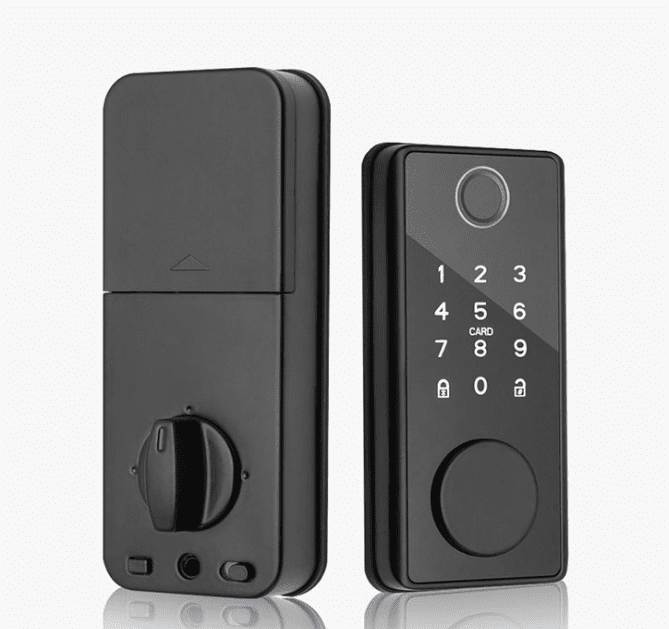
Born from a deep understanding of market needs is the Smart Deadbolt Door Lock — FM 31. This product is designed for the global market and has already covered regions including North America, Europe, Asia, and the Middle East.
This lock supports dual APP ecosystems, Tuya and TT Lock, allowing users to choose different smart home platforms based on preference. It offers multiple unlocking methods: biometric fingerprint, passcode, NFC, RF ID, and mechanical keys, catering to different family members' needs.
Regarding security features, the FM 31 is equipped with multiple smart protection functions: improper attempts alert, privacy mode, low battery alarm, and a scramble code feature to prevent password peeping. Its battery life is equally impressive, with 4 AA batteries lasting a year based on 10 unlocks per day.
The design of the FM 31 fully considers practical home use scenarios. It can store up to 100 fingerprints, 100 cards, and 200 passwords (TT Lock system), sufficient for diverse situations like large families, frequent guests, or short-term rentals.
06 Enterprise Perspective: Balancing Experience and Innovation
In the smart lock industry, a company’s accumulated experience is as important as its innovation capability. As a TÜV-verified smart lock manufacturer and supplier, Sinovo Technologies brings over a decade of ODM & OEM experience, serving global markets since 2013.
Unlike many new companies emerging in recent years, long-term professional accumulation allows for a deeper understanding of different market needs. The company specializes in providing high-quality smart security solutions, with products holding multiple international certifications like CE, FCC, RoHS, and UL.
This long-term development philosophy is particularly vital in a fast-changing market. While many new entrants are still figuring out product design and production processes, experienced enterprises have already established mature supply chains and quality control standards.
Looking ahead, the smart lock market will continue its rapid growth. With further integration of AI and machine learning, smart lock functionalities will become more intelligent and personalized.
Simultaneously, the advancement of smart city initiatives will create new application scenarios for smart locks. Evolving from mere home security devices to integral components of the smart home ecosystem, the future development of smart locks is something to look forward to.
Opening her door, Ms. Chang no longer needs to search for keys; the smart lock silently unlocks via facial recognition. Her three children follow closely, their safe return home already logged by the smart peephole camera.
That lock which once caused arguments for the elderly Taichung couple now quietly guards their home, activating its recognition process only when an authorized user approaches. The smart lock market is projected to reach $15.73 billion by 2035, with a CAGR of about 17.3%.